The notion of Natural Law occupies a significant place in the evolution of legal philosophy and jurisprudence across different civilizations. Natural law theory is based on the notion that law is not only a creation of the state or legislative authority but is derived from universal principles of justice, morality, and reason. These principles are believed to exist freely of human institutions and serve as a guiding benchmark for determining the rationality and legitimacy of positive laws. In Western jurisprudence, natural law theory has been greatly developed by thinkers such as Aristotle, Cicero, Thomas Aquinas, Hugo Grotius, and John Locke, who emphasized that law must comply with moral principles in order to ensure justice and equity in society.
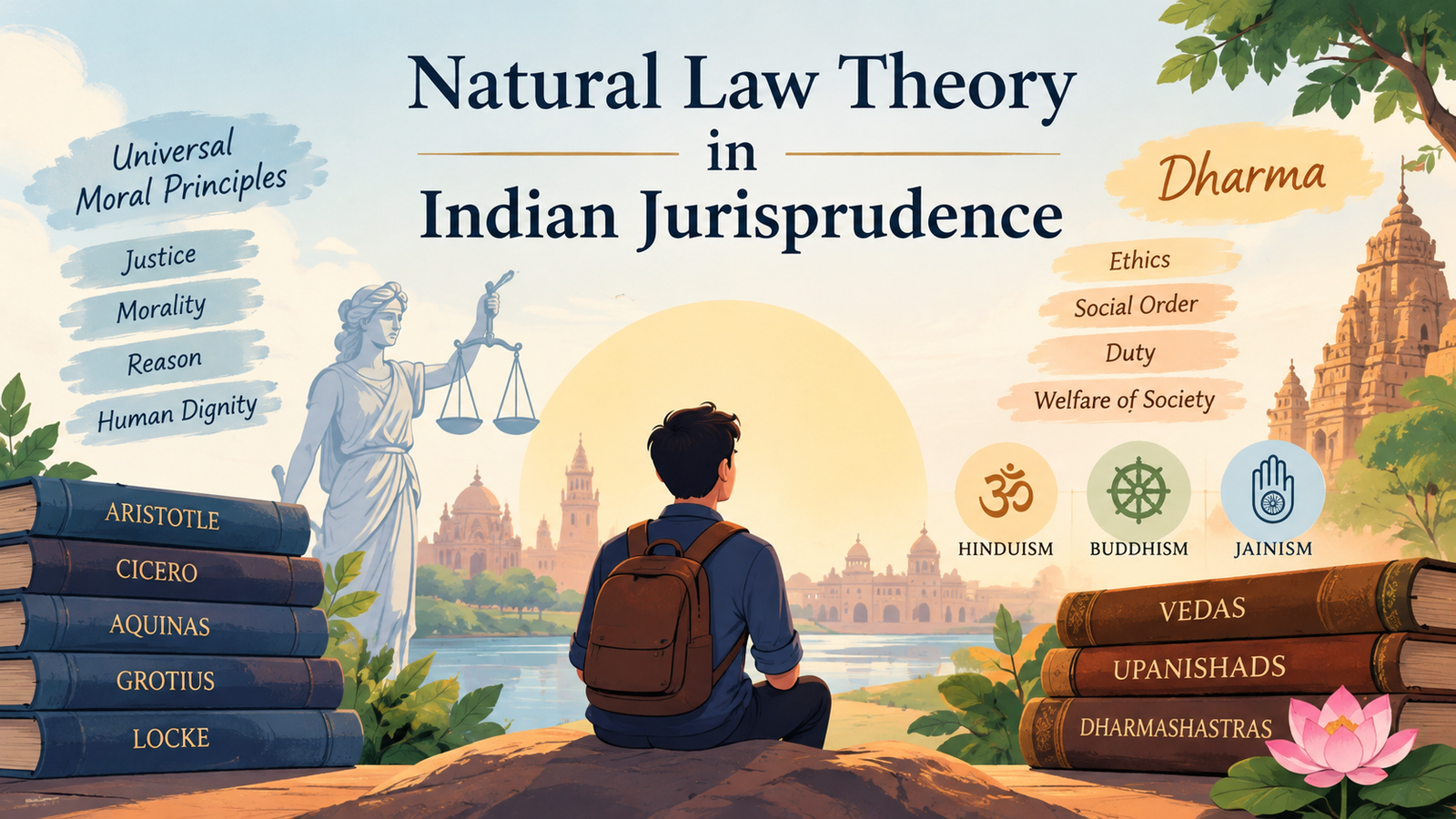
CONCEPT OF DHARMA
In the context of Indian jurisprudence, an analogous philosophical idea is reflected in the concept of Dharma. Dharma is one of the most basic concepts in Indian philosophical, social, and legal traditions. It represents the moral, ethical, and social order that regulates human behaviour and ensures consonance within society.
Unlike the modern positivist view of law, which treats law as the command of a sovereign authority, conventional Indian legal philosophy blends law with morality, ethics, and social duties through the concept of Dharma.
Ancient Indian legal and philosophical texts provide key findings into the concept of Dharma. Scriptures such as Vedas, Upanishads, and Dharmashastras discuss the significance of moral duties and upright behavior as essential elements for maintaining social solidarity and justice. These texts emphasize that the main goal of law and governance is to uphold Dharma and ensure the welfare of society.
RELATIONSHIP BETWEEN DHARMA AND NATURAL LAW
The relationship between Dharma and Natural Law reveals the significant similarities between Indian and Western legal philosophy. Natural law theory asserts that certain moral principles exist independently of human legislation. These principles form the foundation for evaluating the legitimacy of laws.
Similarly, Dharma acts for a higher moral order that guides human behaviour and governance. In ancient India, kings were expected to govern according to Dharma rather than personal interests or high-handedness. A king who violated Dharma was considered unjust and illegitimate.
Natural Law theory also highlights that unjust laws lack moral authority. According to Thomas Aquinas, a law that contradicts ethics cannot be considered a true law. This idea is similar to the Indian belief that laws inconsistent with Dharma are unjust and should not be imposed.
INDIAN PHILOSOPHICAL TRADITIONS
Indian philosophical traditions provide various viewpoints on moral law, justice, and ethical behaviour that closely resemble many ideas associated with natural law theory. Although the concept of "Natural Law" is essentially discussed in Western jurisprudence, Indian philosophical systems have long emphasized the existence of universal moral principles governing human behaviour and social structure. Traditions such as Hinduism, Buddhism, and Jainism emphasize the significance of moral duties, sympathy, and justice, which function as core principles for both individual behaviour and the organization of society.
- Hinduism and Natural Law: Hindu philosophy has played an important role in shaping the concept of moral order and its relationship with law and justice. One of the most prominent concepts in Hindu philosophy is Dharma, which acts for duty, uprightness, and moral obligation. Dharma governs not only individual conduct but also social institutions and governance. According to Vedic philosophy, the universe functions according to a divine and moral order, and human beings must align their actions with this order to maintain consonance, justice, and social stability. This idea bears a strong analogy to the concept of natural law in Western jurisprudence, which suggests that law should be based on a universal ethical code that guide human behaviour.
- Buddhism and Natural Law: Buddhist philosophy provides a deep outlook moral law, Justice and ethical governance. Although Buddhism does not expressly use the term "natural law" in the same way as Western legal thought, many of its principles closely resemble the idea that moral truth and justice arise from shared human ethics. The teachings of Gautam Buddha stress the significance of moral conduct, compassion, intellect, and the alleviation of suffering, these principles form the basis of Buddhist moral philosophy and have substantial impact for law, governance, and social order.
- Jainism and Natural Law: Jain philosophy represents another prominent gift to Indian philosophical and legal thought. Like Hinduism and Buddhism, Jainism stresses the significance of ethical behaviour, moral discipline, and respect for life. Although Jain philosophy does not expressly formulate a theory of natural law, its teachings strongly reflect the idea that universal principles should guide human conduct and social institutions. The teachings of Mahavira highlight strict adherence to moral principles and self control as a basis of a just and harmonious society.
CONSTITUTION OF INDIA & NATURAL LAW
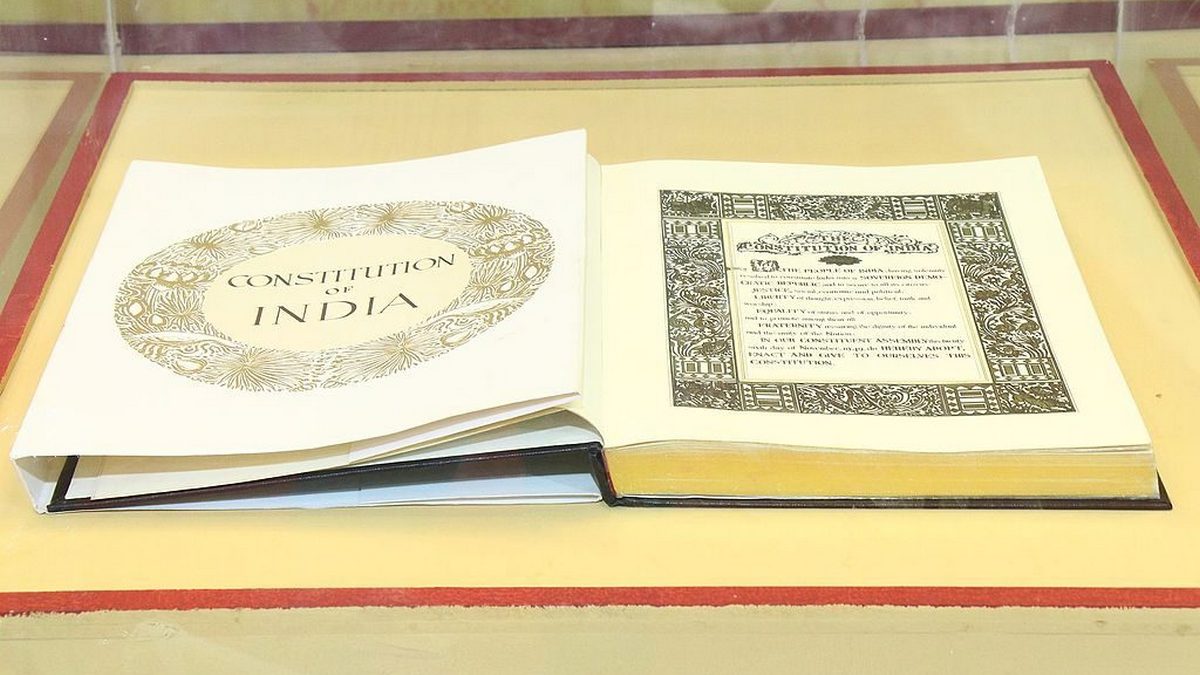
The Indian Constitution implicitly includes principles of natural law and natural justice, stressing human dignity, fairness, and equality even though the text does not expressly define "natural law".
The Preamble
- Main Ideals: It secures social, economic, and political justice, along with equality and liberty, reflecting the prime natural law values.
- Basis: It acts as the theoretical anchor for interpreting rights in alignment with inherent human morality.
Fundamental Rights
- Article14 (Equality): It guarantees equality before the law and equal protection, prohibiting biased state action.
- Article19 (Freedom): It protects basic freedoms like speech and movement while permitting merely reasonable restrictions tested on grounds of fairness.
- Article 21 (Life and Liberty): Judiciary interpreted it dynamically to include human dignity, privacy, and livelihood, anchoring natural rights safely within constitutional law.
Directive Principles of State Policy
These principles act for the moral and social aims that the state should strive to achieve. Although these principles are not legally enforceable in courts, they provide important instructions for governance.
The Directive Principles aim to strengthen social and economic justice, reduce inequalities, and ensure the well being of all citizens. They encourage the state to establish policies that encourage fair distribution of resources, non-discrimination, and equal protection of vulnerable groups.
These principles reflect the ethical responsibilities of the state towards society. In this sense, they embody the ethical values that support Natural Law theory.
Judicial Activism and Interpretation
The Supreme Court of India time and again relies on natural law and natural justice to interpret fundamental rights. In landmark judgements like Maneka Gandhi v. Union of India (1978), the Court held that procedures depriving a person of liberty should be right, just, and fair, injecting substantial due process to natural law.
Basic Structure Doctrine, established in Kesavananda Bharati v. State of Kerala (1973), asserts that certain basic features of the Constitution cannot be amended by Parliament, working as a constitutional law constraint reflecting natural law limits on ultimate authority.
Conclusion
Natural law theory in Indian jurisprudence concludes that state-enacted laws must align with global moral doctrines, fundamental fairness, and dignity of the person. In ancient times, the legal philosophy of India integrated natural law concepts through Dharma (uprightness) and cosmic and ethical order. Fundamental rights and the Preamble of the Indian Constitution reflect natural rights theories by ensuring guarantee to universal rights such as life, liberty, and equality. Indian jurisprudence views not as rigid or out of date, but as a core moral code used to evaluate, interpret, and refine man-made law.
~Pradip Kumar (Assistant Professor)
Join SKSIL Law College and gain hands-on experience with the latest legal technology.